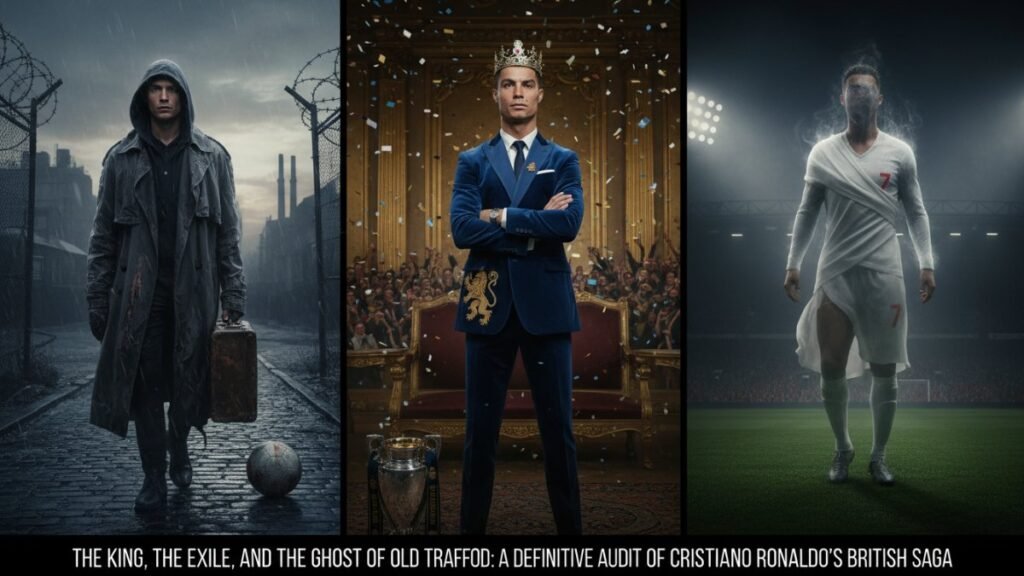

1. The Theatre of Dreams and Nightmares: An Introduction
In the grand, often melodramatic theatre of British football, few protagonists have commanded the spotlight quite like Cristiano Ronaldo dos Santos Aveiro. To walk through Manchester is to walk through a city still haunted by his shadow—a dual spectre of the boy who became a King, and the King who returned only to burn the castle down. As the Editor-in-Chief of this publication, I have witnessed decades of sporting evolution, yet the narrative arc of Ronaldo’s 346 appearances for Manchester United stands as a singular testament to the dizzying heights and crushing lows of modern celebrity culture.
He is not merely a footballer; he is a multinational corporation in shorts, a cultural phenomenon that twice descended upon English shores. The raw data tells us of 145 goals and 64 assists, but numbers are cold comfort to a fanbase torn between adoration and betrayal. His story in the UK is a Shakespearean tragedy wrapped in a Nike commercial. It begins with a spindly teenager with spaghetti in his hair and ends with a scorched-earth interview that severed ties with the very institution that forged him. To understand the United Kingdom’s obsession with Ronaldo is to understand our obsession with greatness itself, and the inevitable, painful realization that even gods bleed. This article does not just recount goals; it dissects the anatomy of a legend who redefined the Premier League, only to find himself at war with its modern iteration.
2. The Chronicle of Two Eras: From Rising Sun to Setting Star
To truly grasp the magnitude of Ronaldo’s footprint, we must forensically examine his two distinct tenures, separated by twelve years of conquest in Madrid and Turin. The first spell, running from 2003 to 2009, was the genesis. Manchester United paid £12.24 million for an unknown quantity from Sporting CP—the most expensive teenager in English history at the time. What we witnessed was alchemy. The 2007-08 season remains the gold standard of individual performance in British football: 42 goals across all competitions, a Premier League title, a Champions League trophy, and the Ballon d’Or. He was untouchable, operating in what statisticians and fans alike refer to as “God Mode.”
Fast forward to the summer of 2021. The narrative of “The Homecoming” was intoxicating. Re-signed for approximately £12.85 million, the romanticism was palpable. And individually, Ronaldo delivered. In a disjointed, struggling side, he finished as the club’s top scorer with 24 goals in the 2021-22 season. He even surpassed Josef Bican to become the all-time leading goalscorer in professional football history while wearing United red. Yet, the ending was far from the fairy tale the media craved. The timeline concludes violently in November 2022. Following a controversial, unauthorized interview with Piers Morgan—where he dismantled the club’s infrastructure and publicly undermined manager Erik ten Hag—his contract was terminated. The contrast is stark: the first exit was a mourning for a lost son; the second was a necessary amputation.
3. The Architecture of Greatness: Origins and The “Ferguson Factor”
The psychological and physical metamorphosis of Cristiano Ronaldo during his first UK residency is perhaps the greatest case study in sporting development. When he arrived in 2003, he was a 75kg lightweight, criticized for excessive flair—too many step-overs, too little end product. By 2009, he was an 84kg machine, built to withstand the brutal physicality of Stoke City away on a rainy Tuesday. This was not accidental; it was engineered.
Central to this evolution was Sir Alex Ferguson. Ronaldo frequently cites the Scotsman as his “football father,” a sentiment that goes beyond cliché. Ferguson offered protection—most notably after the 2006 World Cup incident involving Wayne Rooney, where Ronaldo became public enemy number one in England. Ferguson shielded him, nurtured him, and alongside coach René Meulensteen, stripped away the vanity from his game to reveal a ruthless efficiency. Tactically, he introduced the “knuckleball” free-kick to the Premier League, defying physics and goalkeepers alike. But more importantly, he mastered the aerial game. His header against Chelsea in the 2008 UCL Final was not just a goal; it was a declaration of athletic supremacy, showcasing a vertical leap that NBA players would envy. This section of his career proves that while talent is innate, legendary status in England is forged in the fire of adaptation.
4. The Dimensional Analysis: Commerce, Conflict, and Consensus
To view Ronaldo solely as an athlete is to miss the broader picture of his existence as a commercial entity. His return in 2021 triggered a financial earthquake. Manchester United’s stock price (MANU) surged nearly 10% upon the announcement. Shirt sales obliterated records, generating an estimated £187 million in turnover within the first week alone. He is an economy unto himself, a fact that perhaps emboldened his belief that he was bigger than the club.
However, the view from the terraces is fractured. The “Sir Alex Ferguson” relationship, once a heartwarming subplot, became a complex dynamic in his return, with Ferguson instrumental in hijacking Ronaldo’s potential move to Manchester City. Yet, the departure created a schism. On one side, the “Modern Player Power” advocates argued Ronaldo exposed the Glazer family’s negligence—criticism of crumbling facilities and outdated infrastructure rang true for many. On the other side, proponents of “Managerial Authority” saw a fading star refusing to press, disrupting the tactical cohesion of a modern high-line system. Pundits were divided, with former teammates like Rio Ferdinand often caught in the crossfire between loyalty to their friend and objective analysis of his decline. He won the PFA Player of the Year and FWA Footballer of the Year back-to-back (06/07, 07/08), cementing his status as the best to ever grace the league, yet his final act left a bitter taste that no amount of shirt sales can wash away.
5. Cultural Seismic Shifts: Changing the British Professional Standard
Culturally, Cristiano Ronaldo killed the “Lad Culture” of English football. Before his ascent, the British game was still clinging to a romanticized era of post-match pints and fish and chips. Ronaldo brought a clinically obsessive professionalism that was initially mocked, then feared, and finally copied. Rio Ferdinand and other peers have noted that Ronaldo was the first to employ a personal entourage of excellence: a private chef, a personal physiotherapist, and a sleep coach.
He didn’t just play the game; he optimized his existence for it. This rippled through the academy systems across the UK. Young players looked at Ronaldo and realized that talent was only the entry fee; discipline was the rent due every day. In the high-end entertainment circles of London and Manchester, Ronaldo became the ultimate A-lister, transcending the back pages to dominate the front pages. However, this relentless pursuit of perfection also alienated him. In a British culture that often values humility and self-deprecation, Ronaldo’s supreme confidence and visible frustration with mediocrity (arms thrown up, storming down tunnels) were often interpreted as arrogance. He fundamentally changed the definition of what it means to be a professional athlete in the UK, raising the bar to a height that made his teammates uncomfortable.
6. The Verdict: A Legacy Etched in Gold and Ash
As we look toward the future, the dust is beginning to settle on the Ronaldo saga. History, with its tendency to smooth over rough edges, will likely remember the 145 goals and the 2008 Champions League triumph more vividly than the Piers Morgan interview. He remains part of the undisputed “Greatest United XI,” forming the deadly trident with Rooney and Tevez that terrorized Europe.
The stats—236 Premier League appearances, 103 goals, 3 titles—are immutable. Yet, the lesson of his tenure is a cautionary one for the entertainment and sports industry. It highlights the volatile intersection of individual branding and collective ethos. Ronaldo was the ultimate modern superstar, perhaps too big for a club in transition to handle. His legacy is secure, but complex; he is the hero who stayed long enough to become the villain, only to leave and remind everyone that they still missed him. Manchester United moves on, but the shadow of the number 7 remains long, casting a silhouette that the likes of Marcus Rashford or Alejandro Garnacho must now navigate. In the end, Cristiano Ronaldo conquered England twice: once with his feet, and once with his fame.